

One of the emergencies you’re most likely to encounter is a power outage. While you can survive a brief power outage, a home generator is a must-have item in your preparedness pack for longer power outages.
You require a generator, but what size do you need? To determine this, add the wattage of all the items you wish to power simultaneously, along with the highest-powered device.
When an appliance is in use, its power consumption is calculated by multiplying its wattage rating by the number of hours it uses. Any appliance’s power can be determined by obtaining the product of the wattage and the cumulative hours it uses. One kilowatt hour (kWh) of electricity will be used, for instance, by a 1000-watt electric iron run for one hour.
Appliance Wattage (range)
Clock Radio 10
Clothes Washer 350 – 500
Dishwasher 1200-2400
Hair Dryer 1200-1875
Microwave Oven 750-1100
Laptop 50
Refrigerator 725
36″ Television 133
Toaster 800-1400
Water Heater 4500-5500
Coffee Maker 900 – 1200
Clothes Dryer 1800-5000
Starting watts are the amount of power required to start a device or, to put it another way, the effort put in overtime to build the momentum a device needs to run. The starting watts are also referred to as “surge watts” or “peak watts” because a generator can temporarily supply them in a brief surge.
Running watts is the power required to keep a device operating or work required over time to prevent it from losing momentum. This wattage is continuously available from a generator.
The formula for converting DC amps to watts
Power, abbreviated as P, is equal to the result obtained after multiplying Voltage V and the I (current). Current is measured in amps.
P(W) = I(A) × V(V)
The formula for watts is amps times volts:
watt = amp × volt
or
W = A × V
Even the most essential home appliances, such as the freezer, well pump, refrigerator, and lighting circuits, can be operated with a generator with a power rating of 5,000 to 7,500 watts. All of these appliances can run simultaneously on a 7500 running watt generator. A 3000 to 4000-watt generator will be perfect for an RV.
However, you should check the precise wattage of the home appliances to be 100% certain of the size of the generator that is required to power a house. They are frequently listed in watts or amps on their labels.
A generator’s power when it is first switched on.
What Is the Importance of Starting Watts?
By way of illustration, let me clarify:
During a power outage, you must consider the surge watts of major appliances if you’re utilizing a generator to power your house (i.e., an air conditioner).
If you do not do this, you may be unable to use that specific appliance and, even worse, overload the generator and cause damage.
As previously stated, starting watts (also known as surge watts) are the momentary watts required to start motor-driven devices. In contrast, running watts determine the power required to operate these devices for extended periods.
In addition, generators are rated in terms of starting and running watts, which inform the user of the types of devices that can be plugged into them and, more importantly, the number of devices that can be kept running simultaneously.
Always remember that the generator cannot run continuously at full capacity. Always plan on having more items powered than fewer, and give yourself a safety margin above and beyond the generator’s maximum continuous load.
An overloaded system may heat the contacts and even catch fire. If everything is in order, this might not take place.
The three main categories of generators are standby, inverter, and portable.
When added to gasoline, ethanol raises octane, which improves engine performance and power.
Methanol can be produced from raw materials more easily than ethanol.
d
Diesel typically uses less energy and emits fewer greenhouse gases than gasoline.
Standard diesel engines, as well as vehicles, predominately use biodiesel. Additionally, it can be used to make lubricant and energy.
Natural gas is a versatile, effective, and widely accessible fuel in many nations. The substance has no flavor, color, or aroma. Natural gas ranks as one of the fossil fuels having the lowest environmental effect.
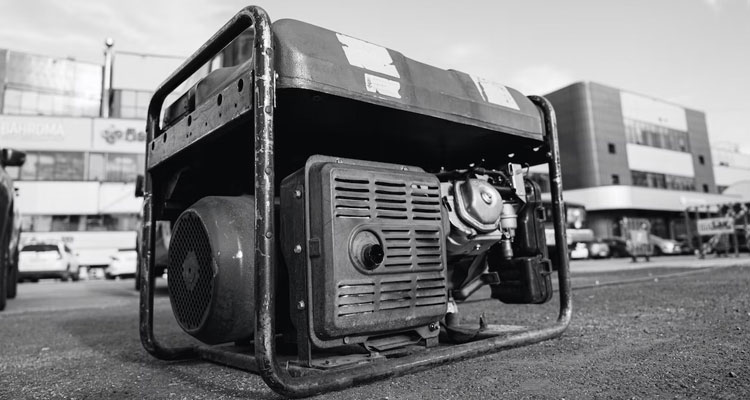
When a gas-powered engine runs, an onboard alternator produces electricity, which is how portable generators produce electricity. The unit’s power outlets accept gadgets, extension cords, and electric tools plugs.
Instead of operating the engine at maximum power all the time, an inverter generator electronically adjusts the throttle to match the demand. You won’t need to fill the gas tank frequently because of the following efficiency improvement. Additionally, inverter generators make fewer emissions and less noise.
When there is a power outage, a standby generator acts as a backup power source, supplying electricity to your facilities, industrial & commercial applications, and business operations. Typically stationary, standby generators need a concrete pad for a foundation outside your facility.
For preparedness enthusiasts residing in apartments and condos, indoor generators—also known as portable power stations—offer a useful substitute. They are safe to use indoors, do not emit fumes or require gas, and can typically be recharged utilizing solar panels.
A portable generator can provide emergency electricity to a residence when the main power source, notably the one from the power grid, fails. It only needs to power necessities like lighting, a TV, a refrigerator, etc., rather than all the appliances in the house. Yes, Provided It Is Sized Properly.
About 2,000 to 3,000 hours are typically the lifespan of a portable gas generator utilized for emergency power in homes. Even though this is much less than the 20,000 to 30,000 hours required by diesel generators, these small generators can last for ten years and are typically used much less frequently.
Transfer switches can safely connect or disconnect various electricity sources from an electric load. In case of a power loss, many residences and businesses are outfitted with standby generators.
Transfer switches make it safe to connect or disconnect various electricity sources from an electric load. Many houses and businesses have a backup generator for when the electricity goes out.
Transfer switches keep electricity from flowing in the opposite direction, like one from a home generator to the electrical grid. This guarantees utility workers won’t be shocked by a homeowner’s generator working on overhead lines.
This is among the factors that lead to the majority of electric codes requiring the utilization of a transfer switch when a home’s electrical panel is connected to a residential generator.
This is among the factors that lead to the majority of electric codes requiring the utilization of a transfer switch when a home’s electrical panel is connected to a residential generator.
When a facility is furnished with numerous utility service feeds, utility-to-utility transfer switches are appropriate. When electric customers within the facility need the choice to switch from one service to another, a utility-to-utility transfer switch is used. An example of a straightforward use case would be a building used for business or industry with two electricity meters but only one electrical system.
At locations with over one on-site power supply, generator-to-generator transfer switches are required. When a home has both solar panels and a generator, it typically necessitates using a generator-to-generator transfer switch.
The AC inverter connected to the solar panels may try to give electricity back to the generator if the two devices are not electrically isolated, posing a risk and possibly destroying the generator and the inverter.
The transfer switch enables the homeowner to alternate power between the generator and the solar panels while maintaining electrical separation between the two systems.
Conservation Tips:

The top ten home energy costs:
The main energy consumers in a home are heating and cooling systems, with your HVAC system at the top of the list. The cost of this crucial apparatus should be kept to a minimum by maintaining it and your home’s insulation.
Heating hot water accounts for 14% of your total power usage, while air conditioning and heating contribute more than 40%. Avoiding water waste is the only trick. Instead of taking baths, take showers, and run the dishwasher rather than doing the dishes by hand.
You cannot live without a refrigerator, although you can cut down on operating expenses. Replace an outdated model with a new one as the first step. Modern refrigerators use less energy than older models and are of higher quality. It also helps to avoid overloading it, keep it at the temperature advised by the manufacturer, and use it effectively. It has to work harder because some of its cold air is lost each time you open the door.

They each consume 5% of your electricity collectively. Once more, efficiency is key. Use cold water, wash a full load every time, but don’t overdo it, and let things air dry if possible.
Despite rarely being used for extended periods every day, ovens and stoves use a lot of electricity, so use them wisely. When possible, use a microwave, toaster, or slow cooker instead of an oven and give it the least amount of time to warm up.
For water and electricity saving, a dishwasher is preferable to hand washing dishes, but you should always wash a full load and utilize economy mode when you can.
Compared to vintage bulbs, modern bulbs consume a lot less electricity. LEDs run at a tenth of the cost of earlier technologies while providing high-quality light and minimal heat.
The available generation of gadgets is energy efficient. It probably uses less than 1% of your total electricity consumption, so if you have a recent TV, there won’t be much to worry about. To save electricity, think about shutting it off at the wall if you’re going to be gone all day or for the weekend.

Modern computers, like TVs, have reasonable power requirements but are often left on. If you switch them off when not in use, they won’t malfunction.
A device may be turned off, but that does not imply it is not still using power. To ensure they don’t draw power while you’re not actively using them, unplug them or even use power strips with on/off switches.
An illustration of the kind of generator required to power a house
So you’re sick of being in the dark during an outage. So that you won’t be left without electricity any longer, you’re probably considering alternatives for a whole-home generator.
To Calculate The Generator Size, You Need To Power Your Entire Home:
Conventional generators must be placed outside. Therefore you cannot use them inside an apartment. Most apartment dwellers don’t have this choice, but if you live in a ground-floor flat with a garden, you might be able to utilize a generator to power the apartment.
But there is another approach. Portable indoor generators could be utilized inside. They can be charged by either mains power or a solar panel instead of burning fossil fuels.
Compared to traditional generators, indoor generators provide far less power. You must decide which electronics and appliances are most important to keep operating because even high-spec versions only provide about 2,000 watts (W) of continuous power.